

Abahlali baseMjondolo / The Residents of the Shacks (South Africa)

democratic socialism

Please note: This is a draft document; the content has not yet been signed off by Abahlali baseMjondolo.
Last updated: 12 December 2025.

1. Background

Despite the end of apartheid in 1994, South Africa is still regarded as the most unequal country in the world1. The top 10% of the population receive 66% of total income, while the bottom half receives just 6%2. Abahlali baseMjondolo / The Residents of the Shacks (generally known as Abahlali) is a struggle-based movement of the country's poorest citizens.
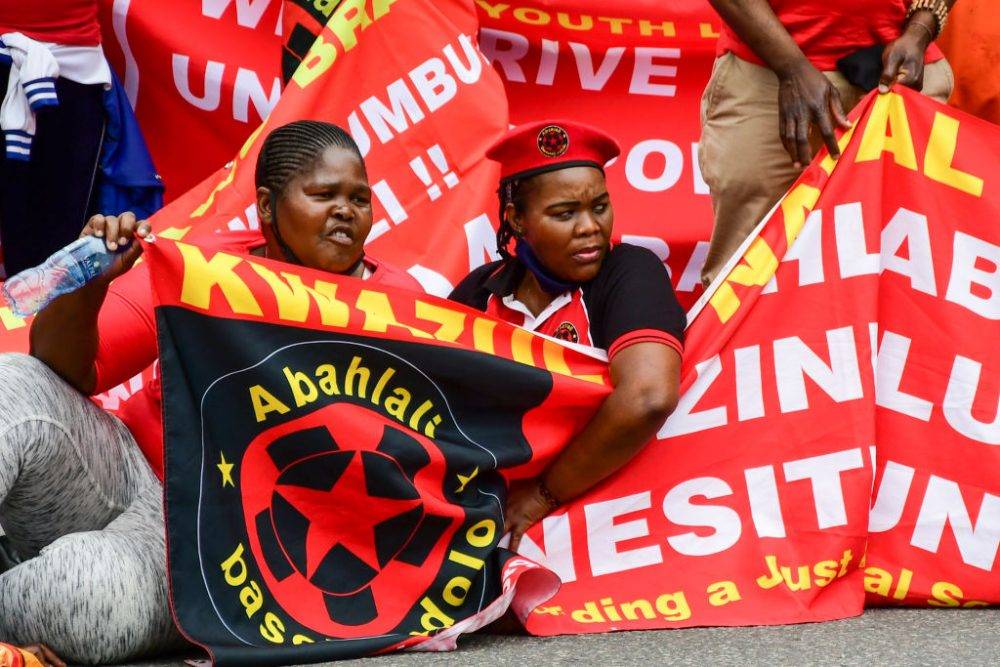
Abahlali developed out of a roadblock protest by shack-dwellers in 2005. The organization's focus is on direct grassroots action, with members carrying out land occupations, resisting evictions, building community infrastructure, organizing water, power and sanitation for shack settlements and running mutual aid projects such as crèches, kitchens and vegetable gardens. Abahlali also campaigns against corruption and discrimination and runs political education courses.

All this happens in spite of extreme violence and repression directed at members by the state, local bodies, property developers and hired thugs. There have been multiple murders, arrests, assaults, destruction of members' homes, and instances of torture. A tribute to those killed can be viewed here.

In one of their many important victories in court, Abahlali won their case against an organized gang of proto-fascist thugs known as Operation Dudula3. They have also won many cases in defence of eviction victims.

The organization's determined focus on improving material conditions has led to strong and fairly consistent membership growth. By 2010 there were 30,000 members, by 2015 it was 50,000, by 2021 it was 85,000, by 2022 it was 102,000. As of December 2025 membership exceeds 180,000.

2. Core positions


The movement is guided by "ubuhlali" - a philosophy of residence, neighborliness and community, deeply rooted in African humanism. linked to this is a structural commitment participative democracy.

"We want the people to own and to manage the blessings and fruits of this world directly. Some of us call this a living communism." 4

"This is the Movement of the poor... The movement only has one program – to be guided by its members." 5

"We are committed to building the democratic power of the oppressed from below, and using our collective strength to create a world in which land, wealth and power are shared fairly — a communist world." 6

"We are a socialist organisation committed to building socialism from below via the construction of popular democratic power." 7

"We have to move beyond capitalism and build a humane economy, an economy that functions in the interests of the people, starting with the worst off, and not private profit." 8

"Our movement has always stood for participatory democracy... as both a means of struggle and a goal of struggle." 9

3. Factions / Caucuses

Membership of Abahlali is dependent upon who you are, not what you think. "Our members are part of every political organisation that you may think of." 10 The philosophy of "ipolitiki ephilayo" (living politics) leads to an environment in which factions are neither condoned nor condemned. Rather, the focus is on the urgent day-to-day challenges of life in the slums. "Poor people do not eat ideology, nor do they live in houses that are made out of ideology”, as Abahlili president S’bu Zikode has put it.11

Factionalism is further avoided by the fact that Abahlali is built around collectives, rather than individuals. "We discourage people from joining Abahlali as individuals — it doesn’t help us, and it doesn’t help them either. So, you will invite us to your community and you organise your community before you become a part of Abahlali. And then, once we make our presentation, we leave the community to engage amongst itself and to decide whether or not they want to join Abahlali as a block. There must be a minimum of fifty members signing to Abahlali." 12

As we can see from the statements in Section 2 above (eg "Our movement has always stood for participatory democracy... as both a means of struggle and a goal of struggle"), Abahlali seeks to maximise internal democracy. "We start from the recognition that we are all equal. We do not struggle to achieve equality. We struggle for the recognition of the equality that already exists... Today I wish to remind comrades that we are also all equal and deserve equal treatment with in our Movement regardless of our positions and tasks." 13

4. Other bodies

A diagram of the Abahlali's organizational structure is available here (page 63).

The movement is based on elected committees in each settlement. The General Assembly, which is open to all members, meets once a month to set priorities for the National Council. The General Assembly can potentially disband any structure within the movement if members feel their demands are being ignored. 14

Importantly, any elected official can be recalled at any time. Their mandate is not to represent people, but to facilitate democratic decision-making on the issues falling under their portfolio15. Branch meetings are open to all (including non members) and settlement committees take important matters to open assemblies, while the movement's Secretariat takes important matters back to the settlement committees. 16

The National Council term runs for three years, provincial council terms run for two years, and local council terms run for one year. There is also a Women’s League and a Youth League, both of which are represented at provincial and national level.

5. International links

Abahlali is determinedly internationalist. "Today we are working towards building a movement of communes and a global movement of movements. In South Africa we are working to unite the left, to rise above divisions and pettiness and connect the progressive membership-based organisations of the poor and the working class around areas of shared principle" 17.

The organization is a member of Progressive International and the International Network for Economic, Social & Cultural Rights (ESCR-Net), and is a Partner of War on Want. They also have solidarity links with the Landless Workers' Movement in Brazil, Sendika in Istanbul, the Combined Harare Residents' Association in Zimbabwe, Clandestino and the Comboni Missionaries in Italy, and Domestic Workers United and the Movement for Justice in el Barrio in the USA, along with the Poverty Initiative and Picture the Homeless. Abahlali is also supported by the Movement Alliance Project and Take Back the Land, both based in the USA.

6. Elections

Abahlali does not stand candidates in elections but has occasionally endorsed other parties for tactical reasons. "Our members are clear that while they understand that electoral politics is just one terrain of struggle and that it should never replace or distract from the work of building popular democratic power from below, of building socialism from below, they do want to be able to vote for a left party in the next election, and that the movement should, working with like-minded membership based organisations, begin a process of considering how to build a political instrument for the people, a political instrument that aims to put the people in power rather than a new set of individuals." 18

In 2024, for instance, after a wide consultation process, they resolved to support the Economic Freedom Fighters party "on condition that... it commits to deliver to the People’s demands as agreed at Abahlali’s General Assembly. To be clear Abahlali is not joining the EFF or offering it uncritical support. This is a tactical vote." 19


  Notes

  1. See https://worldpopulationreview.com/country-rankings/gini-coefficient-by-country
  2. See https://www.aljazeera.com/news/2025/12/10/where-in-the-world-are-wealth-and-income-most-unequal
  3. See https://abahlali.org/node/18556/
  4. See https://abahlali.org/node/7106/
  5. See https://abahlali.org/node/4666/
  6. See https://abahlali.org/about/
  7. See https://abahlali.org/node/17740/
  8. See https://abahlali.org/node/18534/
  9. See https://abahlali.org/node/18534/
  10. See http://abahlali.org/node/17/
  11. See https://www.theafricareport.com/4457/south-africa-from-red-to-blue-abahlalis-survival-and-ideology
  12. See https://abahlali.org/node/16885/
  13. See https://abahlali.org/node/4666/
  14. See https://hammerandhope.org/article/socialist-movement-south-africa
  15. See https://abahlali.org/node/2814/
  16. See https://abahlali.org/node/2814/
  17. See https://abahlali.org/node/18517/
  18. See https://abahlali.org/node/17740/
  19. See https://abahlali.org/node/17757/