

Democratic Socialists of America

democratic socialism

Please note: This is a draft document. The content has not yet been formally signed off by DSA.
Last updated: 12 December 2025.

1. Background

The Democratic Socialists of America (DSA) was formed in 1982, through a merger between the Democratic Socialist Organizing Committee and the New American Movement1, aiming to provide a left response to the rise of neoliberalism. For the first 30 years membership numbers hovered between 5,000 and 8,000.
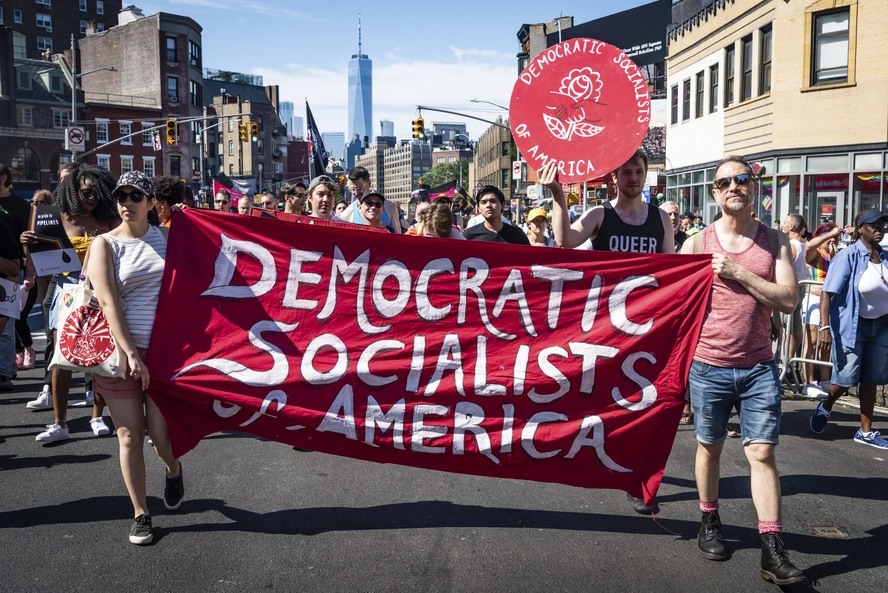
This began to change in 2015, with the first presidential campaign of Senator Bernie Sanders. Sanders openly identified as a democratic socialist, although he has never been a member of DSA, and he received full endorsement and support from the party. Ironically, Trump’s victory in 2017 also resulted in thousands of new members joining DSA2.  Over the next few years Party activists were heavily involved in movements such as #MeToo and Black Lives Matter. This attracted further members, including a large cohort of young people. Between 2013 and 2017 the median age of DSA membership was reduced from 68 to 333. By 2025 membership had reached 85,0004.

The latest membership growth appears to be the result of active involvement in the struggle for Palestine, the HandsOff, 50501 and No Kings mobilizations, the Fighting Oligarchy Tour led by Sanders and DSA member Alexandria Ocasio-Cortez, and the successful NYC mayoralty campaign of Zohran Mamdani, along with similar electoral successes elsewhere5.
2. Core positions

The organization’s purpose is set out in the DSA Constitution:

“We are socialists because we reject an economic order based on private profit, alienated labor, gross inequalities of wealth and power, discrimination based on race, gender identity, sexual orientation, disability status, age, religion, and national origin, and brutality and violence in defense of the status quo. We are socialists because we share a vision of a humane social order based on popular control of resources and production, economic planning, equitable distribution, feminism, racial equality, and non-oppressive relationships. We are socialists because we are developing a concrete strategy for achieving that vision, for building a majority movement that will make democratic socialism a reality in America. We believe that such a strategy must acknowledge the class structure of American society and that this class structure means that there is a basic conflict of interest between those sectors with enormous economic power and the vast majority of the population.” 6

We believe that working people should run both the economy and society democratically to meet human needs, not to make profits for a few.” 7

3. Factions / Caucuses

DSA has no single “line”, but is rather designed to include the widest range of tendencies within socialism… the organization is meant to be a big tent that includes all socialists from the center-left to the far-left. This diversity has developed a strong culture of debate, open thought, and ultimately substantially greater membership numbers than other more sectarian organizations…” 8

When people join their local chapter of DSA they may also opt to join a DSA caucus. These groups (sometimes referred to as ‘slates’) are like party factions but are totally accepted and integrated into the DSA structure, and contribute to its strength and dynamism. Some of the current caucuses are:

Groundwork (https://www.groundworkdsa.com/about/)
Reformist eco-socialists who work nationally on the Green New Deal campaign.

Socialist Majority Caucus (https://www.socialistmajority.com)
Supporters of “the democratic road to socialist revolution” who aim to build a socialist majority via U.S. elections and the Democratic Party.

Springs of Revolution (https://sordsa.org/)
A network aiming to transform DSA into a revolutionary mass political force.

Red Star (https://redstarcaucus.org)
A ‘big tent’ socialist organizing group agitating for revolutionary Marxism within a new democratic workers’ party.

Marxist Unity Group (https://www.marxistunity.com)
Orthodox Marxists and democratic centralists inspired by the Second International, Lenin, and the Bolsheviks.

Reform and Revolution (https://reformandrevolution.org)
Former members of Socialist Alternative — the largest Trotskyist party in the U.S.

Libertarian Socialist Caucus (https://dsa-lsc.org)
Anarchists, autonomist Marxists, and communalists who prioritize militant labour and tenant unions, cooperatives, mutual aid societies, and other autonomous democratic formations.

Carnation
A new caucus seeking to blend center-left Marxism with far-left perspectives, and wanting to DSA to become a political party.

Bread and Roses (https://breadandrosesdsa.org)
Members who promote a Marxist “democratic road to socialism” through rank-and-file labour organizing.

Anti-Zionist Slate
Dedicated to advancing the cause of Palestinian liberation.

Constellation Caucus (https://www.ydsaconstellation.org)
A youth-specific caucus focused on building infrastructure and promoting diversity.

Communist Caucus (https://communistcaucus.com)
Marxists that prioritise base-building through militant labor and tenant organizing.

Emerge (https://dsaemerge.org)
Communist and autonomist Marxists whose core focus is building independent working-class institutions with participatory democracy.

Red Labor
Members calling for unity through democratic centralism, a total break from the Democratic Party and creation of a new socialist party.

These and other caucuses vie for positions within the peak national body, the National Political Committee (NPC). Following the 2025 elections the NPC is comprised of:
•  5 members from Groundwork
•  4 members from Socialist Majority Caucus
•  4 members from Springs of Revolution
•  3 members from Red Star
•  3 members from Marxist Unity Group
•  2 members from Reform and Revolution
•  1 member from the Libertarian Socialist Caucus
•  1 member from Carnation
•  1 independent member

4. Other bodies

As well as the caucuses above, there are several other national bodies that members can join. Afrosocialists and Socialists of Color (AFROSOC)9 supports and develops non-white DSA members as leaders in the organization. The National Labor Commission (NLC)10 is for members active in the labor movement and the Green New Deal Campaign Commission (GNDCC)11 seeks to build green projects and expand public services for a Green New Deal.

5. International links

DSA was a member of the second Socialist International from 1982 to 2017. They withdrew in 2017 over S.I.’s collaboration with the neoliberal programme. In 2023 they became an associate member of the São Paulo Forum (https://forodesaopaulo.org) and a full member of the Progressive International (https://progressive.international)

6. Elections

DSA does not operate as a political party in its own name but has increasingly engaged in electoral politics through the endorsement of candidates (both members and non-members) who align with DSA values. Several such candidates have been elected to the House of Representatives, including Alexandria Ocasio-Cortez, Rashida Tlaib, Cori Bush, Jamaal Bowman and Greg Casar. Social critic and former presidential candidate Cornel West is also a member of DSA. Zohran Mamdani beat Andrew Cuomo in the New York mayoralty race and as at August 2025 there were more than 250 democratic socialists in office across 40 states12. Much to the confusion of external analysts, but fully in keeping with democratic socialist principles, some caucuses call for a total break from the Democratic Party while others seek to influence it.


Notes

  1. See https://www.dsausa.org/about-us/history/
  2. See https://www.dsausa.org/about-us/history/#beyond.
  3. See https://www.nytimes.com/2025/11/07/style/american-socialism-dsa-mamdani.html
  4. See https://dsausa.org. “The Democratic Socialists of America is the largest socialist organization in the United States, with over 85,000 members.” Website footer 1 December 2025.
  5. See https://independentpoliticalreport.com/2025/11/democratic-socialists-of-america-identify-12-wins-from-2025-election-cycle-with-two-runoffs-ahead/
  6. See https://www.dsausa.org/about-us/constitution/#P1B
  7. See https://convention2025.dsausa.org/
  8. See https://dsa-lsc.org/2025/01/31/a-guide-to-dsa-politics/
  9. See https://www.dsausa.org/working-groups/afrosocialists-and-socialists-of-color-caucus/
  10. See https://labor.dsausa.org/
  11. See https://ecosocialists.dsausa.org/about/
  12. See https://www.rollingstone.com/politics/politics-features/democratic-socialists-convention-chicago-1235401434/