
 The World Inequality Lab ('the Lab') claims: "extreme wealth inequality is rapidly increasing".1 Conversely, the International Monetary Fund (IMF) claims: "Global inequality has been declining fast since the 1990s".2 Conservative commentators leap upon the latter narrative and claim that capitalism has lifted hundreds of millions out of poverty. What's really going on?!
The Lab and the IMF are both run by leading academics and they both draw on much the same data.3 However, they mean very different things when they use the word 'inequality'. In this article I will argue that the Lab's narrative is grounded in fact; the IMF's narrative is a fudge; and the conservative version of events is simply a fallacy.
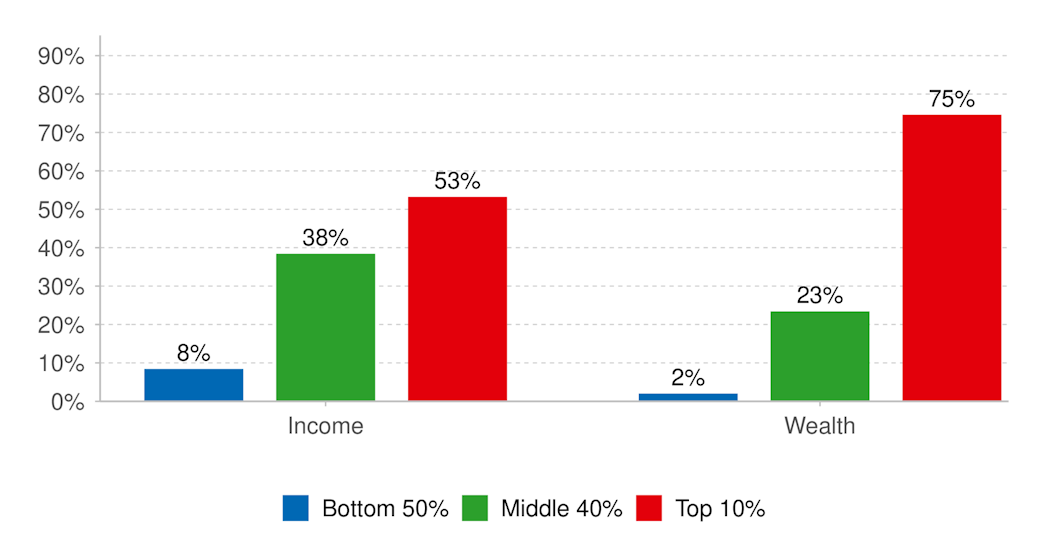
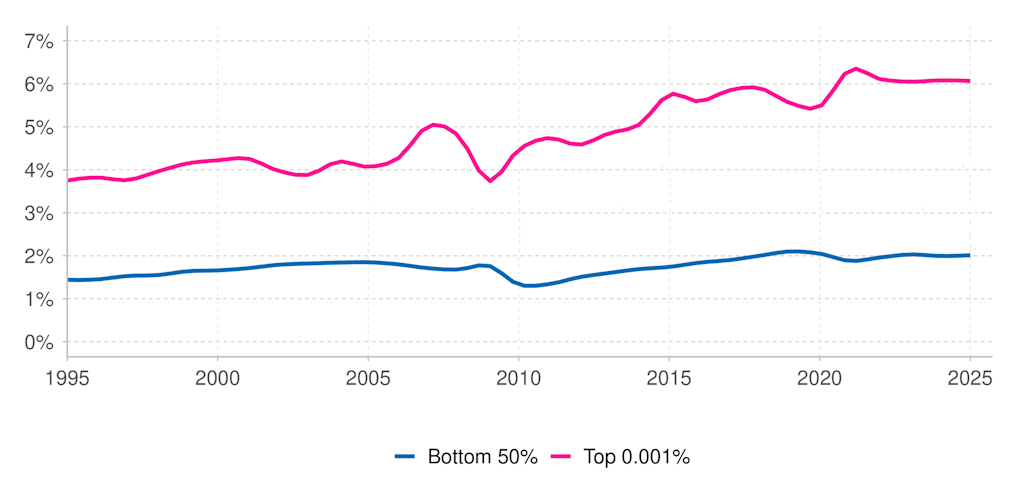
According to the Lab's latest report4, the richest 10% of the world's population now owns 75% of the world's wealth. By comparison, the bottom 50% owns a mere 2%.5 The same report claims "...the wealthiest 0.001% alone... control today three times more wealth than half of humanity combined. ...This concentration is not only persistent, but it is also accelerating."
Taken from "World Inequality Report", World Inequality Lab (2026)
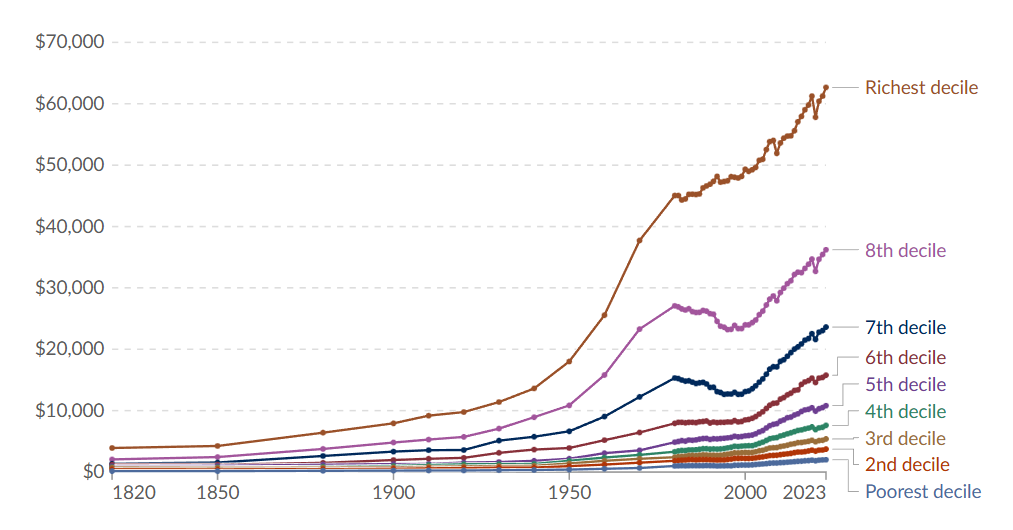
The Lab's data and methodology are sound.10 Moreover, applying the same methodology over the past 100+ years, a clear trend emerges: the more you have, the more you get. The graph below was produced by Our World in Data, based on the Lab's 2025 report. (Figures adjusted for inflation and for differences in living costs between countries).
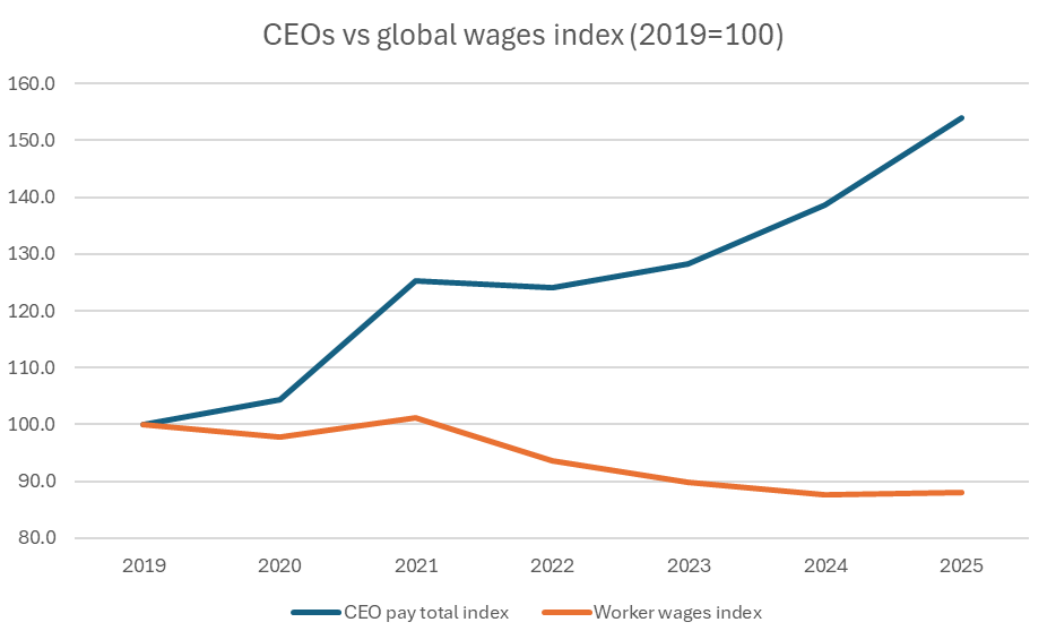
Taken from "Working for the rich: The Growing Divide Between Workers and Fat Cats", Oxfam and ITUC, 2026
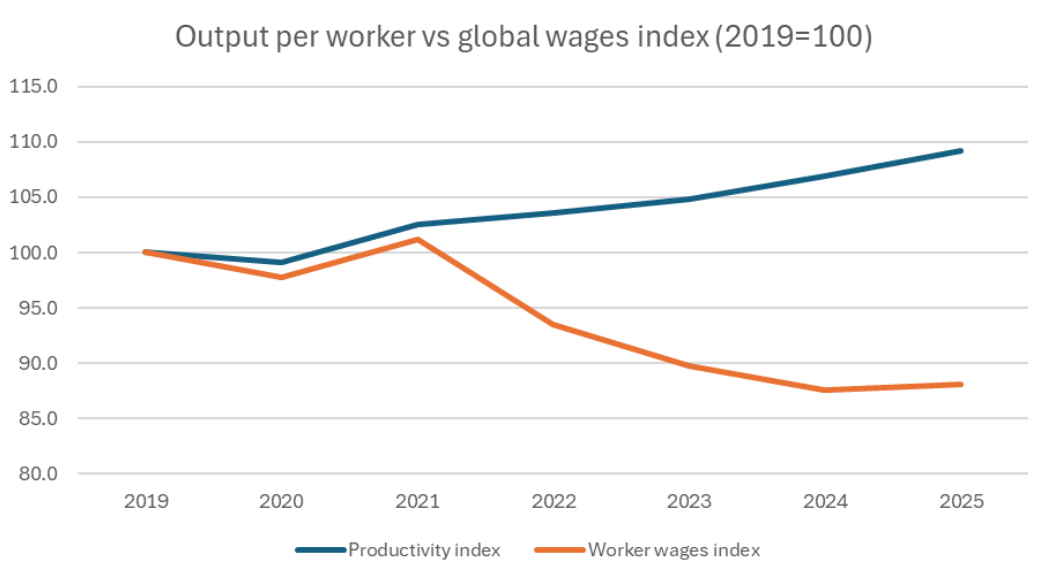
But...
Despite occasional statements to the contrary, the IMF seems adamant that global inequality has been declining13. We will look at what they actually mean in a moment, but first some general notes on the data.It is important to note that the IMF version of events is based on the GINI coefficient, which looks at income, rather than net wealth. Because taxes are often based on income, the ultra-rich have developed various mechanisms that allow them to minimize the amount they must declare. IRS papers leaked to ProPublica in 202114 showed the results. Whereas the average American taxpayer pays about 14.5 percent...
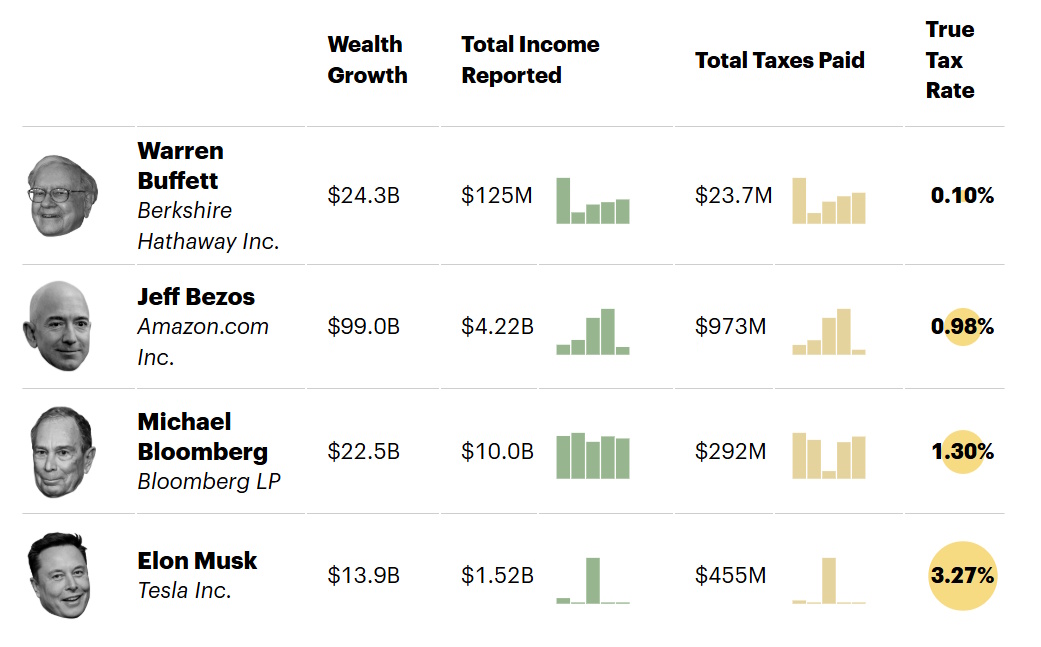
(Figures relate to tax paid from 2014 to 2018)
Let's take a longer view and see what we find. Evidence suggests that the rise of capitalism was initially accompanied by a sharp rise in extreme poverty19 until somewhere between 1880 and 1900.20 Why then?
"...existing data indicates that progress was achieved with the rise of organized labour, the anti-colonial movement, and other progressive social movements, which organized production around meeting human needs, redistributed wealth, and invested in public provisioning systems..." 21
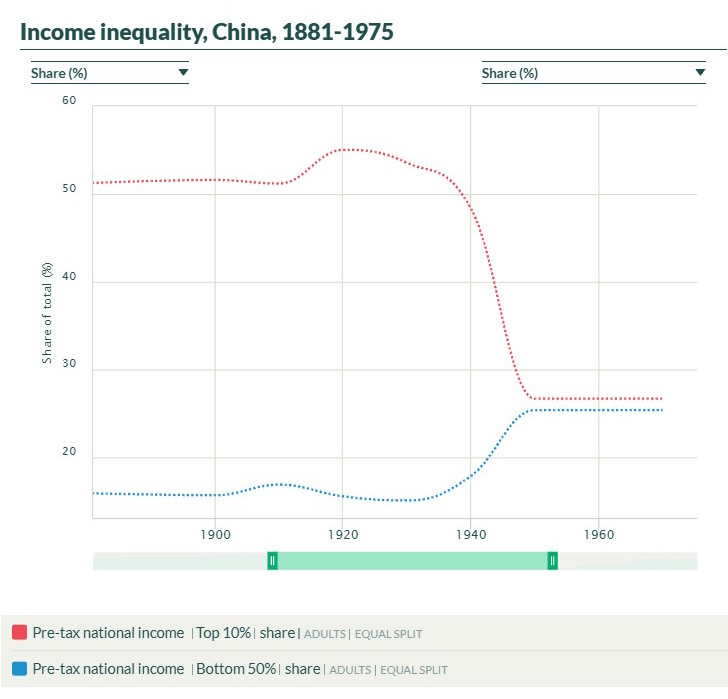
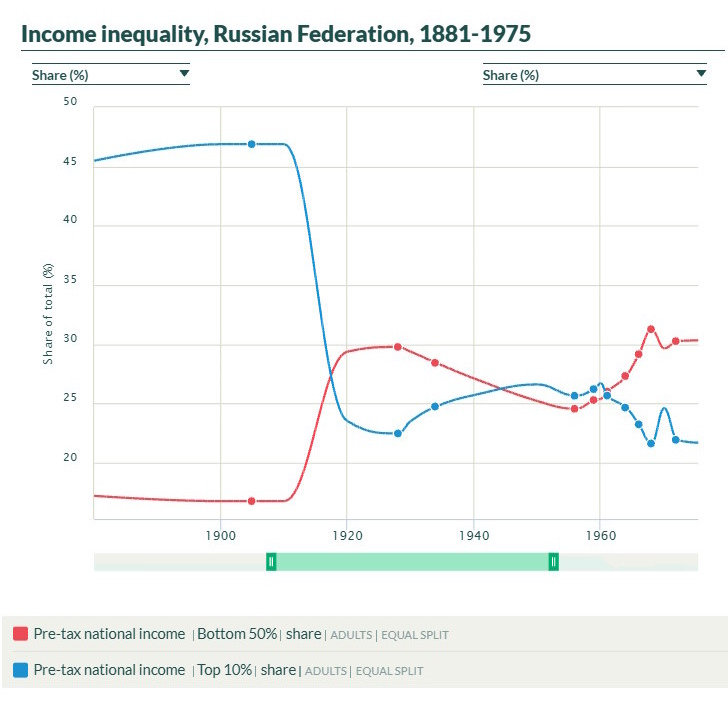
In a related argument, we should note that the two leading contributors to any reduction of inequality in the 20th century (if there was one) were both avowedly anti-capitalist nations: China and the USSR. From the Lab database:22
Nevertheless, in their 'Introduction to Inequality'24 the IMF again maintains that inequality is decreasing. However, they qualify this by saying (emphasis added):
"Within-country inequality has risen in most countries. While the progress in the reduction of global inequality over the last thirty years has been remarkable, within-country inequalities have increased, especially in advanced economies. Over the past three decades, more than half of the countries and close to 90 percent of advanced economies have seen an increase in income inequality."
That's right: the official IMF line is that global inequality is decreasing except for most people in most countries.
This sounds like an absolute nonsense until you grasp the counter-intuitive way in which they are applying the term. They are talking about inequality between nations. This is completely different from what the Lab measures: the gap between rich and poor within nations. The Global Governance Forum has summed up the difference in this way: "The gap between nations has narrowed, but the gap between neighbors has widened."25
I used the word 'counter-intuitive' above because, I would suggest, people weigh questions of equality and fairness by looking across their own society. It wouldn't occur to me to measure my relative position, as a working person in New Zealand, with that of a worker living in South Sudan. I wouldn't even know how to make such a comparison in any useful or meaningful way. Nevertheless, this abstract formulation is being used by the IMF to trumpet a massive reduction in inequality.
Is it reasonable to take this approach even further, as many conservative commentators have done26, and suggest that capitalism deserves credit for lifting hundreds of millions out of poverty? This is where we start to find some interesting twists in the story. Here's one:
"From 1820 to 1980, rich countries surged ahead while most others lagged. But within many countries – particularly in the West – inequality declined during the postwar period, thanks to strong welfare states, progressive taxation, and inclusive growth. Since around 1980, these trends have reversed."27
And here's another. According to the World Bank, China has lifted more than 850 million of its citizens out of extreme poverty. The country's poverty rate fell from 88% in 1981 to 0.7% in 201528.
The IMF does not highlight the case of China in their narrative, even though it represents almost the whole of their total in terms of inequality reduction. Why not? Rather, they make abstruse statements such as: "...per capita GDP growth rates accelerated in less developed countries, particularly in Asia, resulting in convergence in income levels across countries".29
In short, the data does not point to any particular success story relating to capitalism. On the contrary, the IMF set and adjust their paramaters for 'extreme poverty' in such a way that they get a result are happy with. For instance: "There is a strong consensus among scholars that the $1.25 line is far too low, but it remains in official use because it is the only line that shows any progress against poverty - at least when you include China - and therefore is the only line that justifies the present economic order."
In his book "The Divide: A brief guide to global inequality and its solutions" (Penguin 2017), from which the above quote is taken, Prof. Jason Hickel takes an in-depth look at how this kind of 'creative' accounting has been used to disguise increases in both inequality and extreme poverty, and shows that these have occurred both within countries and between them. To call the IMF's conclusions 'fudge' is probably excessively diplomatic.
In the few cases where there have been reductions in poverty, these have achieved through determined resistance to capitalism. Whether it be the rise of unions and anti-colonialist movements in the 1880s-1900; socialist revolutions in the twentieth century; or the social democratic compromise after WWII... popular reactions against free-market capitalism are what produced progress.
On the flip side of the equation, as the World Inequality Database shows in country after country, the rise of neoliberalism post-1970s led to renewed levels of inequality.
Inequality takes a political form
More wealth leads to more influence, which leads to more wealth which leads to more influence, and so on. We know this. "Data from 136 countries confirms that as economic resources become more unequally distributed, so too does political power." 30 In 2025 polling by Oxfam across 36 countries31 found that 86% of respondents either agreed or strongly agreed with the statement: "the top cause of economic equality is that 'rich people have too much political influence'".The mechanisms that link inequalities in economics with those in politics have been thoroughly established and studied (elite networks, political donations, media control, think tanks, various forms of bribery, lobbying, subsidies, partisan appointments, tax breaks, etc). Unfortunately, nobody has yet worked out how to track such corruption globally. That said, we can measure the net results.
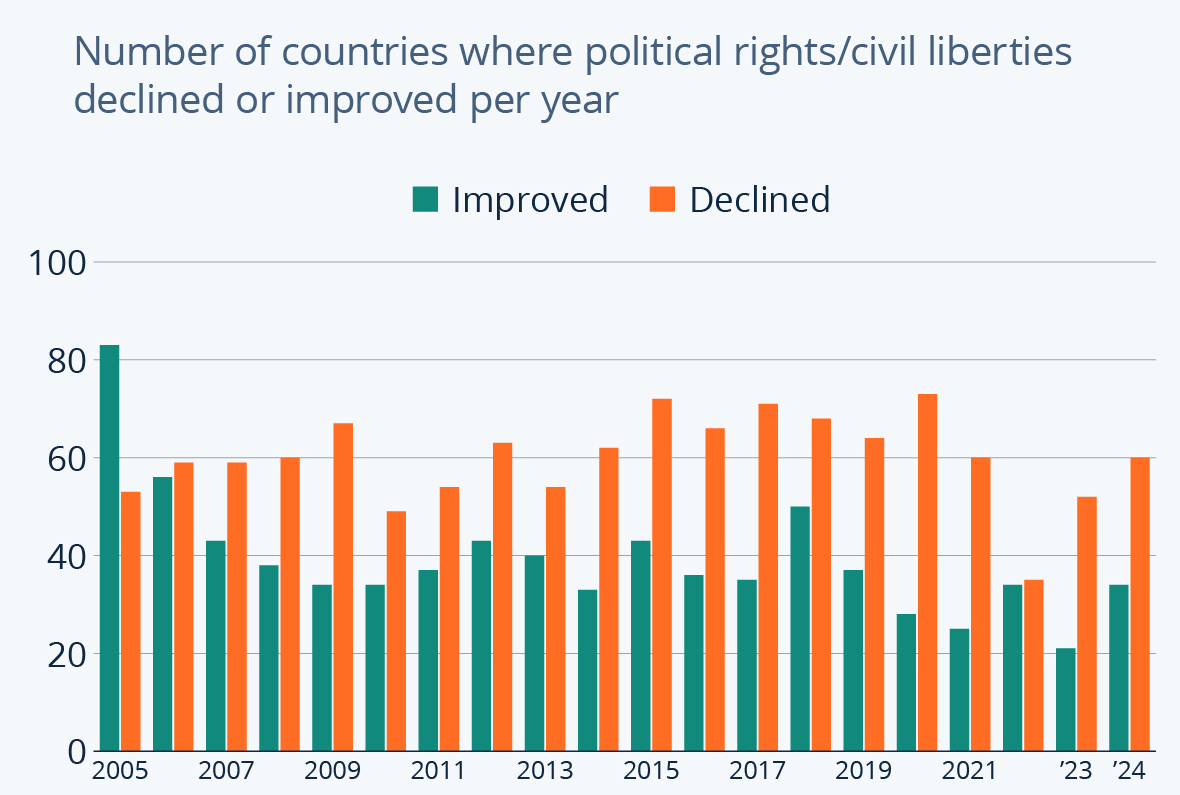
In short, "...inequality and democratic erosion are linked... The association between inequality and risk of democratic backsliding is robust, and holds under different measures and structures of both income inequality and wealth inequality". 32 Data from Freedom House shows that political rights and civil liberties have declined for 18 consecutive years. Statista presents the findings thus:
The problem is clear enough. "Billionaire wealth jump(ed) three times faster in 2025 to highest peak ever, sparking dangerous political inequality." 33 The following comment (from the Global Governance Forum) seems rather relevant:
"When people believe that the economic system no longer delivers its benefits equitably, they begin to lose faith in its legitimacy. That loss of trust can lead people to withdraw from civic life, sabotage institutions, or empower populists who promise to upend the system altogether. In this way, growing domestic inequality contributes directly to political polarization, social fragmentation, and the erosion of democratic norms."34
The solution is clear enough as well. As the Lab puts it, in wrapping up their 2026 report: "Inequality is a political choice. It is the result of our policies, institutions and governance structures... The challenge is political will."
The rise of democratic alternatives
"The challenge is political will". That sounds simple enough, doesn't it? But neoliberal and postliberal governments have been thoroughly complicit, if not instrumental, in the growth of inequality. Political will needs to extend beyond seasonal visits to the ballot box. As Jason Hickel from the Global Inequality Project has said: "it will require organised political struggle".35It seems that 2026 may prove a watershed year in this regard. For a start, two expert teams have been working on ambitious projects designed to turn the tide. That hoary neoliberal shibboleth "there is no alternative" is being definitively laid to rest.
1) The Lab followed up their 2026 report on inequality with 'The Global Justice Project'.
"the first attempt to propose a fully quantified plan... combining four dimensions that today's debates often treat separately: redistribution at the world scale, a deep reform of the international financial and economic order, a radical transformation of energy systems, and substantial shifts in consumption patterns." 36
2) At the same time a collaborative team of UN agencies, national governments, academic experts, civil society organisations, trade unions, NGOs and grassroots movements has been putting together the 'Roadmap for Eradicating Poverty Beyond Growth'.
"The Roadmap puts forward a toolkit of concrete policy measures that offer a vision and strategy for building a global economy that places human rights, ecological justice, and participatory governance at its center." 37
We don't have the space here to go into the ins and outs of these two projects but it's important to note that they are simultaneously radical and mainstream works. You'll probably recognise some of the names involved: Thomas Piketty, Olivier De Schutter, Joseph Stiglitz, Gabriel Zucman, Jayati Ghosh, Kate Raworth, Jason Hickel, etc. These people will not be found tearing up flagstones anytime soon, they are leading academics, Nobel prize winners and research analysts. But what is important to note is that they have come to their conclusions through analysis, rather than the need to put flesh on the bones of ideology. They are not socialists in any 20th century sense, they do not even use the word, yet here they are arguing for economic democracy, a massive redistribution of wealth, climate justice, and the democratisation of work.
The big problem, as Grace Blakely has identified, is that, without organization, all this amounts to is 'asking nicely for an end to capitalism'.38. That's where another key development of 2026 comes in. Democratic socialism has gone mainstream. From New York to Seattle to Washington DC, more US cities are selecting democratic socialist leaders and representatives. This needs to be seen as part of a developing international phenomenon. In 2018 Ipsos found that 50% of survey respondents across 28 countries think: "socialist ideals are of great value for societal progress".39 That figure is just as high in some of the bastions of capitalism.40
Using a fairly strict definition, the Democratic Socialist Project has identified developing democratic socialist organizations in more than 50 countries.41 Do these people all have the same goals in mind? No. Are they a monolithic force? No. But this appears to be part of the reason membership is growing so fast. As we can see from parties like the DSA in America and Die Linke in Germany, both of which have doubled their membership in the last two years, democratic socialism thrives when factions address their differences in the course of community organizing, rather than through sectarian debate.
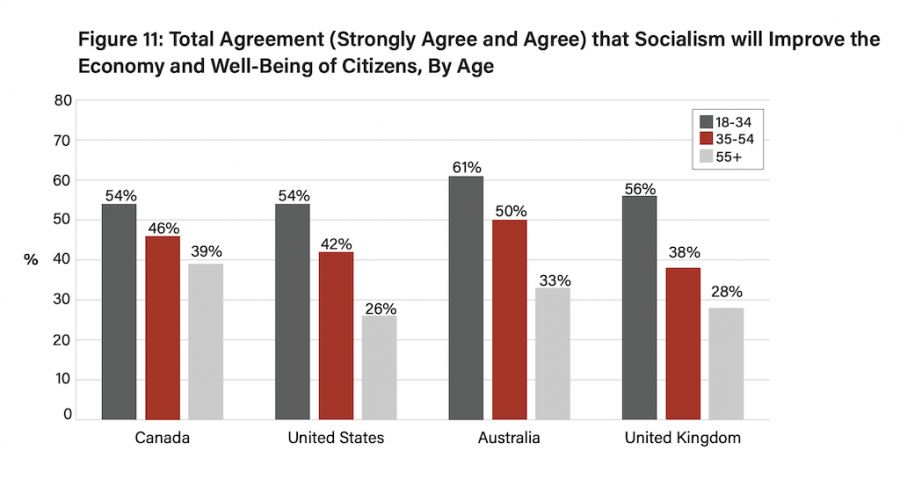
There are developing alternatives to inequality, then. Transforming economics might seem like a tall order but we have already seen how inequality levels change according to social pressure, whether it be the rise of organized labour and anti-colonial movements in the late 19th century, socialism in the early twentieth century, social democracy in the 1940s, and (on the flipside of the coin) neoliberalism in the 1980s. The rise of democratic socialism represents a new, countervailing force. The World Inequality Lab is an important part of this; the IMF is not.
I have suggested that 2026 may represent a turning point. No doubt many will see this as overly optimistic. Donald Trump certainly feels threatened. He has called the democratic socialists "more dangerous to the U.S. than previous world wars and the Sept. 11, 2001, terrorist attacks" and "the biggest threat to our nation there is, maybe since our founding".
And, on that note, I shall leave you to pick a side.
By Peter Hall-Jones
- See https://wid.world/document/world-inequality-report-2026/
- See https://www.imf.org/en/topics/inequality/introduction-to-inequality
- The World Inequality Lab officially cites the IMF as a key source for its macroeconomic and government finance data. This is detailed in the Lab's technical documentation, and includes: Government Finance Statistics used to analyze government revenue, expenditure, and budgets; Public Sector Balance Sheet data providing information on government assets and liabilities; The Global Debt Database, a source for information on public debt, and the Investment and Capital Stock Dataset, used for estimating public and private capital stocks.
- See World Inequality Report 2026
- The World Inequality Report, produced by the World Inequality Lab, draws on the work of over 200 scholars around the world and is co-ordinated by leading academics such as Thomas Piketty and Gabriel Zucman. More on the team here.
- They also added: "...current disparities are extreme. The poorest half of the global population owns just €2,900 (in purchasing power parity) per adult, while the top 10 percent owns roughly 190 times as much. Income inequalities are not much better. The richest 10 percent today snap up 52 percent of all income. The poorest half get just 8.5 percent."See https://www.imf.org/en/publications/fandd/issues/2022/03/global-inequalities-stanley?ct=5830&page=24.
- Dabla-Norris, M.E., M.K. Kochhar, M.N. Suphaphiphat, M.F. Ricka and E. Tsounta (2015), Causes and consequences of income inequality: a global perspective, IMF,Washington D.C"
- See https://www.oecd.org/content/dam/oecd/en/publications/reports/2011/12/divided-we-stand_g1g1483d/9789264119536-en.pdf."
- See https://documents1.worldbank.org/curated/en/099101424092027337/pdf/P500855154ddde0b31827a1e9377c43d15e.pdf
- Those who want to dig deeper into this debate should look at the exchange that took place in 2016, as the IMF challenged Thomas Piketty's methodology (https://www.imf.org/external/pubs/ft/wp/2016/wp16160.pdf). Piketty responded here: https://thomaspiketty.wordpress.com/2016/09/21/the-imf-the-inequality-debate-and-economic-research/. As you can see this is a polite debate between scholars rather than a heated dispute, as some commentators would have it.
- See https://www.ituc-csi.org/IMG/pdf/working_for_the_rich_media_briefing_sans_embargoed.pdf
- See "Resisting the rule of the rich: Protecting freedom from billionaire power", Oxfam (2026), summarised here.
- See https://www.imf.org/en/topics/inequality/introduction-to-inequality
- See https://www.propublica.org/article/the-secret-irs-files-trove-of-never-before-seen-records-reveal-how-the-wealthiest-avoid-income-tax
- This was a massive leak of more than 11.5 million financial and legal records, which showed financial and attorney–client information for more than 214,488 offshore entities. The documents showed how the global elite obscured their wealth (legally and illegally) through hard-to-trace companies and tax havens. See https://www.icij.org/investigations/panama-papers/
- For a look at the mechanisms they use, see https://www.icij.org/inside-icij/2017/09/7-charts-show-how-rich-hide-their-cash/
- See https://www.oxfam.org.uk/media/press-releases/355-trillion-may-be-hidden-in-offshore-tax-havens/
- See https://www.oxfam.org/en/press-releases/soon-be-trillionaire-elon-musks-wealth-grew-over-1-million-minute-last-year
- See https://www.sciencedirect.com/science/article/pii/S0305750X22002169
- See https://www.sciencedirect.com/science/article/pii/S0305750X22002169
- See https://www.sciencedirect.com/science/article/pii/S0305750X22002169
- These tables were configured for the period 1881 to 1975 from data in the World Inequality Database. See https://wid.world/country/china/ and https://wid.world/country/russian-federation/ respectively.
- See https://www.bu.edu/gdp/2021/04/05/imf-austerity-is-alive-and-impacting-poverty-and-inequality/
- See "Introduction to Inequality": https://www.imf.org/en/topics/inequality/introduction-to-inequality
- See https://globalgovernanceforum.org/global-inequality-has-gone-local-and-why-this-matters/
- For instance Stephen Pinker says: "modern societies have been devoting an increasing proportion of that wealth to benefiting those less well-off." (more). Rainer Zitelmann says: "Capitalism has done more to overcome hunger and poverty than any other system in world history" (more). Arthur Brooks says that the alleged reduction of extreme poverty around the world arises from: "...free trade and the spread of property rights and the role of law and and the culture of entrepreneurship" (see "Is Capitalism Broken", One World Publications, 2020). Hickel and Sullivan debunk such claims in depth here.
- See https://globalgovernanceforum.org/global-inequality-has-gone-local-and-why-this-matters/.
- See https://www.worldbank.org/en/news/press-release/2022/04/01/lifting-800-million-people-out-of-poverty-new-report-looks-at-lessons-from-china-s-experience. However, for a deeper and more far-reaching analysis of what has happened in China, see https://www.tandfonline.com/doi/full/10.1080/13563467.2023.2217087#abstract.
- See https://www.imf.org/en/topics/inequality/introduction-to-inequality
- See https://oi-files-d8-prod.s3.eu-west-2.amazonaws.com/s3fs-public/2026-01/EN%20-%20Resisting%20the%20Rule%20of%20the%20Rich.pdf
- See Resisting the rule of the rich, Oxfam (2026)
- See https://pubmed.ncbi.nlm.nih.gov/39793070/
- See https://www.oxfam.org/en/press-releases/billionaire-wealth-jumps-three-times-faster-2025-highest-peak-ever-sparking.
- See https://globalgovernanceforum.org/global-inequality-has-gone-local-and-why-this-matters/.
- See https://www.theguardian.com/environment/2026/jun/04/world-inequality-lab-equality-academics-planetary-survival.
- See https://globaljusticeproject.wid.world/insight/summary/.
- See https://www.neep-poverty.org/roadmap-for-eradicating-poverty-beyond-growth/.
- See https://graceblakeley.substack.com/p/asking-nicely-for-the-end-of-capitalism.
- See https://www.ipsos.com/en/globally-half-think-socialist-ideals-are-great-value.
- See https://jacobin.com/2025/09/new-poll-democratic-socialism-mainstream.
- See https://democratic-socialist.net/#survey-list.