


Movimento dos Trabalhadores Rurais Sem Terra / The Landless Workers’ Movement (Brazil)

democratic socialism

Please note: This is a draft document; the content has not yet been signed off by MST.
Last updated: 15 December 2025.

1. Background

Brazil is one of the most unequal countries in the world1, with the poorest 50% of the population receiving only 9% of national income2 and 64 million people suffering from severe hunger or food insecurity3. This is not for lack of natural resources. One of the central problems is that 46% of the country's land is in the hands of 1% of landowners4. That's where Movimento dos Trabalhadores Rurais Sem Terra (MST) comes in.
Article 5, XXIII of the Brazilian Constitution states that "property shall comply with its social purpose", and Article 184 says: "The Union has the power to expropriate on account of social interest, for purposes of agrarian reform, the rural property which is not performing its social function" 5. In other words, the use and tenure of land, especially when it is unoccupied and serving no purpose, can be contested.

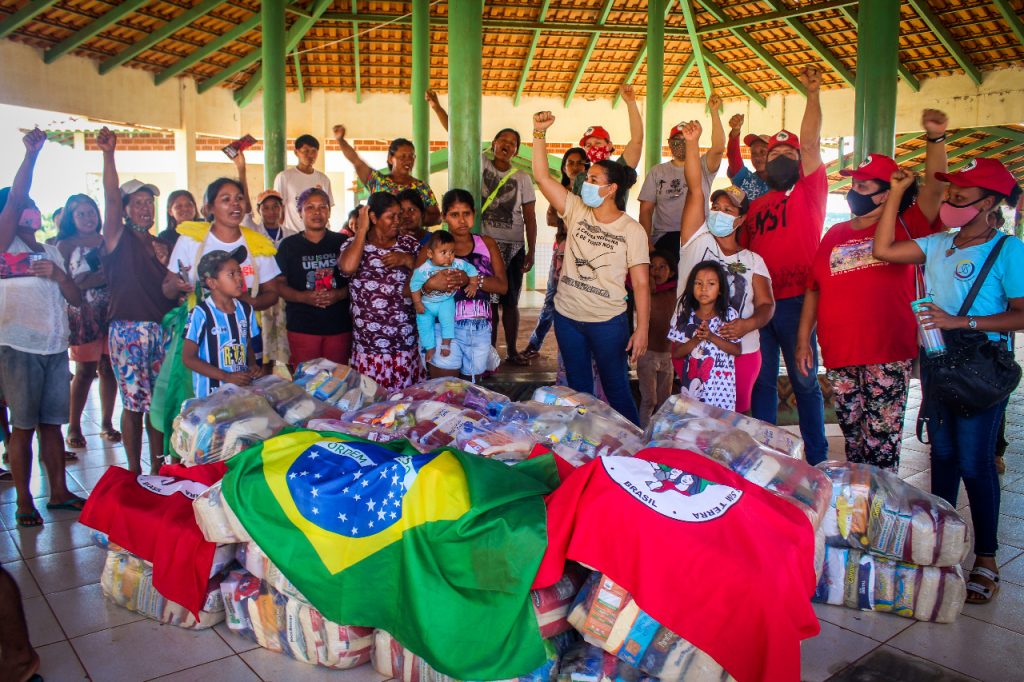
MST, the world's largest social movement, has its roots in this struggle. It grew out of Brazil's land occupation movement. It became a national organization in 1984 and since then about 450,000 families have won land tenure through struggle and organization, with another 65,000 fighting for legal recognition6.

With a membership of about 1.5 million, MST is the largest progressive movement in South America7. It is hard to grasp the sheer scale of MST's operations. There are around 1,900 productive associations, 185 cooperatives, and 120 agribusinesses spread across MST settlements and camp areas8. "...the movement also develops a rural education project, with more than 2,000 schools and 200,000 students, in addition to the Florestan Fernandes National School" 9. In 2022 MST launched a plan to plant 100 million trees within 10 years 10.

Reactions against MST activism have sometimes been brutal, with a series of massacres and more than 300 activists murdered11, often with impunity12. Many more have been attacked and illegally evicted. For many of Brazil's poorest citizens, this is a life and death struggle.

2. Core positions

 

"The MST (Landless Workers' Movement) wages an anti-capitalist, anti-patriarchal, and anti-racist struggle and understands that its settlements and encampments must be spaces free from LGBTphobia... We want a country that creates and permanently utilizes mechanisms for direct participation and decision-making by the population in the various instances of political and social power, building a true participatory popular democracy... We need policies and practices from our leaders that guarantee the full sovereignty of our people over our territory, our natural resources, minerals, biodiversity, water, and seeds. The State must have control, coupled with the participation of society and workers, and of strategic companies for national development that already exist, and create new companies as necessary to manage these resources... The MST's International Relations Collective (CRI) has the role of articulating solidarity with the struggles of landless workers, contributing to the resistance of peoples, and awakening and improving, within our social base, the values ​​that make us more humane and united, builders of a socialist society." 13

The objectives of MST are:
• To fight for land;
• To fight for Agrarian Reform;
• To fight for a more just and fraternal society.
14

"We call upon the Brazilian people to fight the necessary battles, maintain the permanent struggle, and build a just and egalitarian society. A socialist society!" 15

The MST National Coordination Meeting has emphasized its commitment to "Exercising internationalism and solidarity as principles, values, and strategies to build the socialist struggle; hand in hand with Cuba, Palestine, Venezuela, Haiti, the peoples of Africa, and the working class of the world" 16

"Founded on anti-capitalist, anti-imperialist, anti-racist and anti-patriarchal pillars, the (Brasil People’s Project) program requires building unity among many groups and individuals. We are facing the crisis of the capitalist mode of production. Financial capitalism does not produce goods and does not solve the basic needs of the population. As a way out, a new climate emerges in Brazilian society to discuss projects. Projects with post-capitalist foundations because we have already seen that capitalism does not solve our problems." 17

3. Factions / Caucuses

As we saw with Abahlali baseMjondolo, membership of MST is dependent upon who you are, not what you think. Members might be Marxists, anarchists, communists or Bolivarians, while others are syndicalists, social democrats or followers of liberation theology. Factions are neither condemned not condoned. However, like Abahlali, an organizing structure centered around collectives rather than individuals serves to reduce ideological disparities. The fundamental organizing unit within the MST is the 'base group' - a small collective of landless families or individuals. Decisions are rarely made by vote, most are made by consensus. "If there is no consensus, they return to their groups with new questions, seeking to synthesise the discussion and reach collective decisions." 18

In 1997 a group of workers within MST set up the Movimento dos Trabalhadores Sem Teto / the Homeless Workers' Movement to push for land reform on behalf of the homeless in the cities. This now an autonomous group19, although it maintains a strategic alliance with MST.

Following a massacre in 199520 a group of members broke away, angered by what they saw as reformism in MST, and set up a separate Marxist-Leninist group called the League of Poor Peasants.

4. Other bodies

MST sees itself as a social movement rather than a political party and has no formal leadership other than a dispersed group of about 15 leaders, whose public appearances are scarce. As noted earlier, the 'base group' is the fundamental organisational unit. Each group elects members to represent them at settlement and regional meetings, and regional representatives elect members to the State Coordinating Body and the National Coordinating Body. Wherever possible, leadership positions are occupied by both a man and a woman. Each of the collective units make decisions through discussion, reflection, and consensus. This emphasis on the collective serves to downplays the role of leaders, and reduces the risk of arrest, corruption and assassination.

Over time 'Sectors' have developed to deal (at both local and national levels) with specific areas of work such as cooperation, communications, culture, discipline, education, environment, gender, health, human rights, internationalism, political education, production, and youth. Another Sect or known as 'The Mass Front' engages in recruitment activities, while the Discipline Sector enforces the rules; domestic violence and child abuse, for example, lead to automatic expulsion, and drug use is prohibited.

Other groups include the Women’s Collective, Landless Kids and the National Directory. MST also plays a leading role in the Popular Brazil Front, the National Forum for Agrarian Reform, and the Coordination of Social Movements. Florestan Fernandes National School is MST's national political education center.

5. International links

MST is part of Via Campesina, which brings together rural social movements from five continents. It is also a member of the International Peoples' Assembly and the Bolivarian Alliance for the Peoples of Our America (ALBA).

MST emphasizes its commitment to "Exercising internationalism and solidarity as principles, values, and strategies to build the socialist struggle; hand in hand with Cuba, Palestine, Venezuela, Haiti, the peoples of Africa, and the working class of the world" 21. Several 'international brigades' exist to find ways of building this solidarity.22 For instance, MST gathered roughly 13 tonnes of food to send to Palestinians in Gaza between October and December 2023.

International support for the work of MST is also expressed by various "Friends committees" around the world. 23. Several 'international brigades' exist to find ways of building this solidarity.24

6. Elections

MST usually participates in elections by supporting or endorsing third party candidates. In general, they offer critical support to the Workers' Party. However, in 2024, for the first time, they also fielded candidates under their own name. Seven of the 15 candidates were elected, four to the state legislatures and three to the national Congress.25 A year earlier MST had fielded more than 700 candidates in municipal elections, including both members and allies of MST. 26

Video produced by The Real News Network.

Notes

  1. See https://worldpopulationreview.com/country-rankings/gini-coefficient-by-country
  2. See https://wir2026.wid.world/www-site/uploads/2025/12/World_Inequality_Report_2026.pdf
  3. See https://www1.folha.uol.com.br/internacional/en/business/2024/04/642-million-live-in-households-with-food-insecurity-in-brazil.shtml
  4. See https://jacobin.com/2025/12/brazil-landless-workers-movement-food
  5. See https://www.stf.jus.br/arquivo/cms/legislacaoConstituicao/anexo/brazil_federal_constitution.pdf
  6. See https://thetricontinental.org/dossier-75-landless-workers-movement-brazil/#_edn3
  7. See https://venezuelanalysis.com/news/venezuelan-govt-joins-forces-with-brazils-mst-to-boost-agroecological-food-production/
  8. See https://jacobin.com/2025/12/brazil-landless-workers-movement-food
  9. See https://mst.org.br/2025/05/26/a-ocupacao-de-terras-no-brasil/ (translated)
  10. See https://mst.org.br/2024/09/22/candidaturas-do-mst-defendem-politicas-publicas-contra-a-fome-e-por-direitos-nos-municipios/
  11. See https://www.earthisland.org/journal/index.php/magazine/entry/the-growing-political-clout-of-landless-farmworkers-in-brazil/ (translated)
  12. See https://forestsandfinance.org/news/measured-grave-the-deaths-in-the-fight-for-land-in-brazil/, https://cptnacional.org.br/2023/04/14/conflitos-no-campo-brasil-2023/, https://conectas.org/en/noticias/brazil-is-the-country-that-most-kills-land-activists-according-to-report-by-global-witness/ and
    https://www.amnesty.org/en/latest/press-release/2016/04/the-eldorado-dos-carajas-massacre-20-years-of-impunity-and-violence-in-brazil/
  13. See https://mst.org.br/quem-somos/ (translated)
  14. See https://www.mstbrazil.org/content/objectives-mst (translated)
  15. See https://mst.org.br/2020/01/25/coordenacao-nacional-do-mst-lanca-carta-ao-povo-brasileiro/ (translated)
  16. See https://mst.org.br/2025/03/14/a-solidariedade-entre-os-povos-esta-no-centro-do-internacionalismo-do-mst-diz-dirigente/ (translated)
  17. See https://mst.org.br/2020/11/13/mst-discusses-proposals-for-building-a-peoples-project-in-brazil/
  18. See https://thetricontinental.org/dossier-75-landless-workers-movement-brazil/#_edn3
  19. See https://globaldialogue.isa-sociology.org/articles/the-growth-of-brazils-homeless-workers-movement
  20. See https://www.amnesty.org/en/documents/AMR19/016/1995/en/
  21. See https://mst.org.br/2025/03/14/a-solidariedade-entre-os-povos-esta-no-centro-do-internacionalismo-do-mst-diz-dirigente/" (translated)
  22. See https://mst.org.br/brigadas-internacionalistas/ (translated)
  23. See https://mst.org.br/comites-de-amigos-as/ (translated)
  24. See https://mst.org.br/brigadas-internacionalistas/ (translated)
  25. See https://mst.org.br/2022/11/24/mobilizing-people-power-beyond-elections-in-brazil/
  26. See https://mst.org.br/2024/07/12/brazils-landless-rural-workers-movement-launches-over-700-pre-candidates-for-2024-elections/